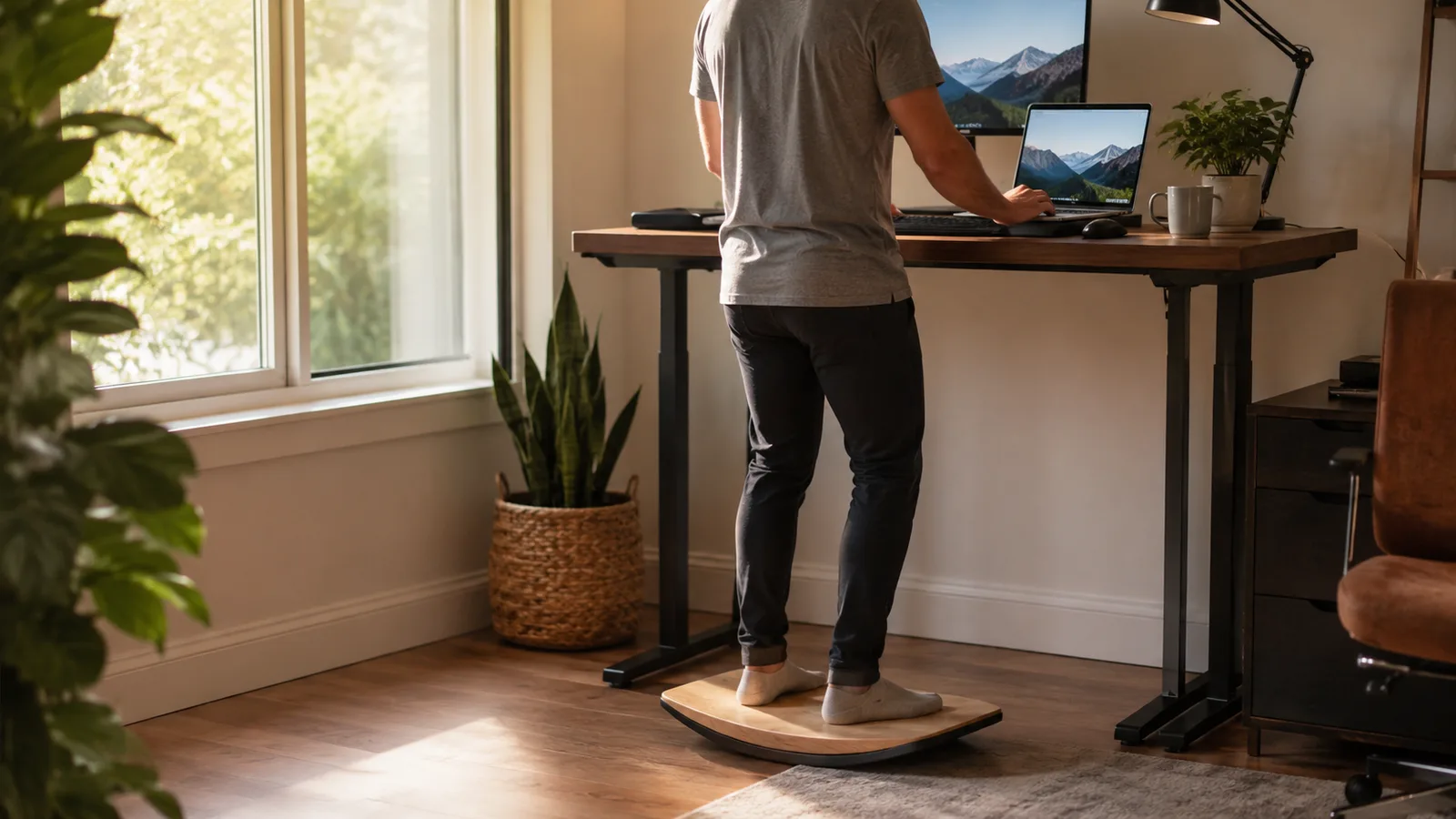
Three months ago I would have told you a mat was all you need under a standing desk. I ran an anti-fatigue mat under mine for almost two years in my home office, and it did the one job I asked of it, my feet stopped aching by 4pm. Then my physical therapist pointed out that standing still on a soft mat is still standing still. Your hips lock, your lower back stiffens, you just don't notice it as fast because the cushion masks the early warning signs. That sent me into a three-month side-by-side test, swapping the mat for the StrongTek Wooden Balance Board every other week under my keyboard tray, tracking how each one actually felt by the end of a nine-hour workday.
Here's the short answer before I get into specifics. If your only complaint is sore feet from standing on hardwood or tile, a mat solves that cheaply and you don't need anything fancier. If your complaint is the 2pm stiffness, the restless legs under your desk, the urge to just sit down out of boredom rather than fatigue, the StrongTek balance board solves a different problem a mat physically cannot touch. It keeps your ankles, calves, and core working in small ways the entire time you're standing, instead of just standing on something softer.
How I Ran the Test
I've worked remote as an IT project manager for eight years now, and most of that has been at a standing desk in my spare bedroom, so I had a long baseline with the mat before I ever touched a balance board. For the test, I gave each surface two full weeks at a time, alternating for three months, so I wasn't comparing one great day to one bad day. I logged three things every evening around 5pm, how stiff my lower back felt on a 1 to 5 scale, whether I'd felt the usual 2:30 energy dip, and how many times I'd caught myself wanting to sit down out of restlessness rather than actual tiredness.
My desk setup didn't change during any of this, same standing desk, same monitor height, same eight to ten hours a day of stand-up meetings, code reviews, and client calls. The only variable was what was under my feet. By the end of the third mat rotation I already had a strong hunch which surface was winning, but I kept the schedule anyway because I didn't want to talk myself into a result before the data backed it up.
| Feature | StrongTek Balance Board | Anti-Fatigue Mat |
|---|---|---|
| Price | Check today's price on Amazon | Mid-range typical cost |
| Material | Solid birch wood deck, non-slip grip surface | High-density foam or gel core, rubber base |
| Primary Benefit | Constant micro-movement, engages ankles and core | Cushions joints from hard flooring |
| Footprint | 15.7 inch round base | 20 by 32 inch rectangle |
| Learning Curve | A few days to find a stable stance | None, step on and go |
| On Video Calls | Takes practice to hold a still frame | Completely still, camera-safe from day one |
| Durability | Solid wood, no compression over time | Foam flattens and compresses in 12 to 18 months |
| Best For | Stiffness, restlessness, afternoon energy dips | Sore feet from hard flooring, camera-heavy days |
Where the StrongTek Balance Board Wins
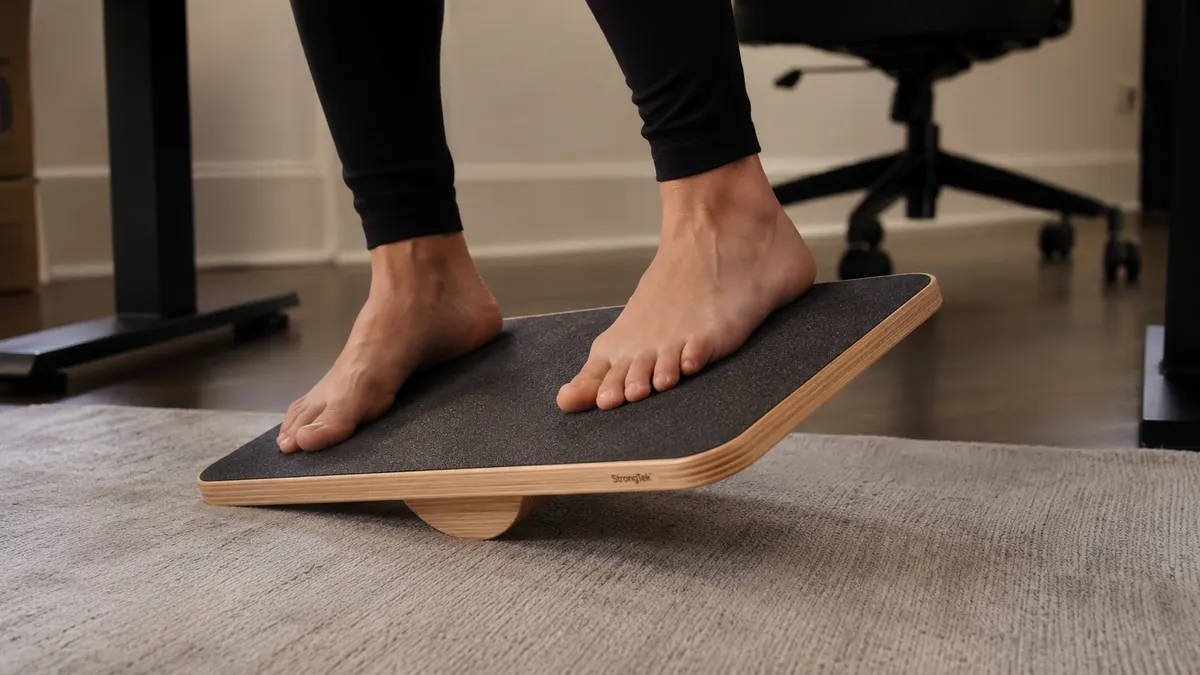
The StrongTek's whole design is built around one idea, don't let your body go still. The board has two sides, a flat rocker side with a gentle curve for beginners, and a fully round 360 degree wobble side once you've built up some ankle control. I started on the rocker side my first week, standing on it during morning stand-ups when I only needed to half pay attention, and moved to the wobble side by week three. Once I could hold a stable stance through a 30 minute call without looking down, the difference in how my legs felt at 5pm was obvious. No stiffness, no need to shift my weight every ten minutes just to stay comfortable.
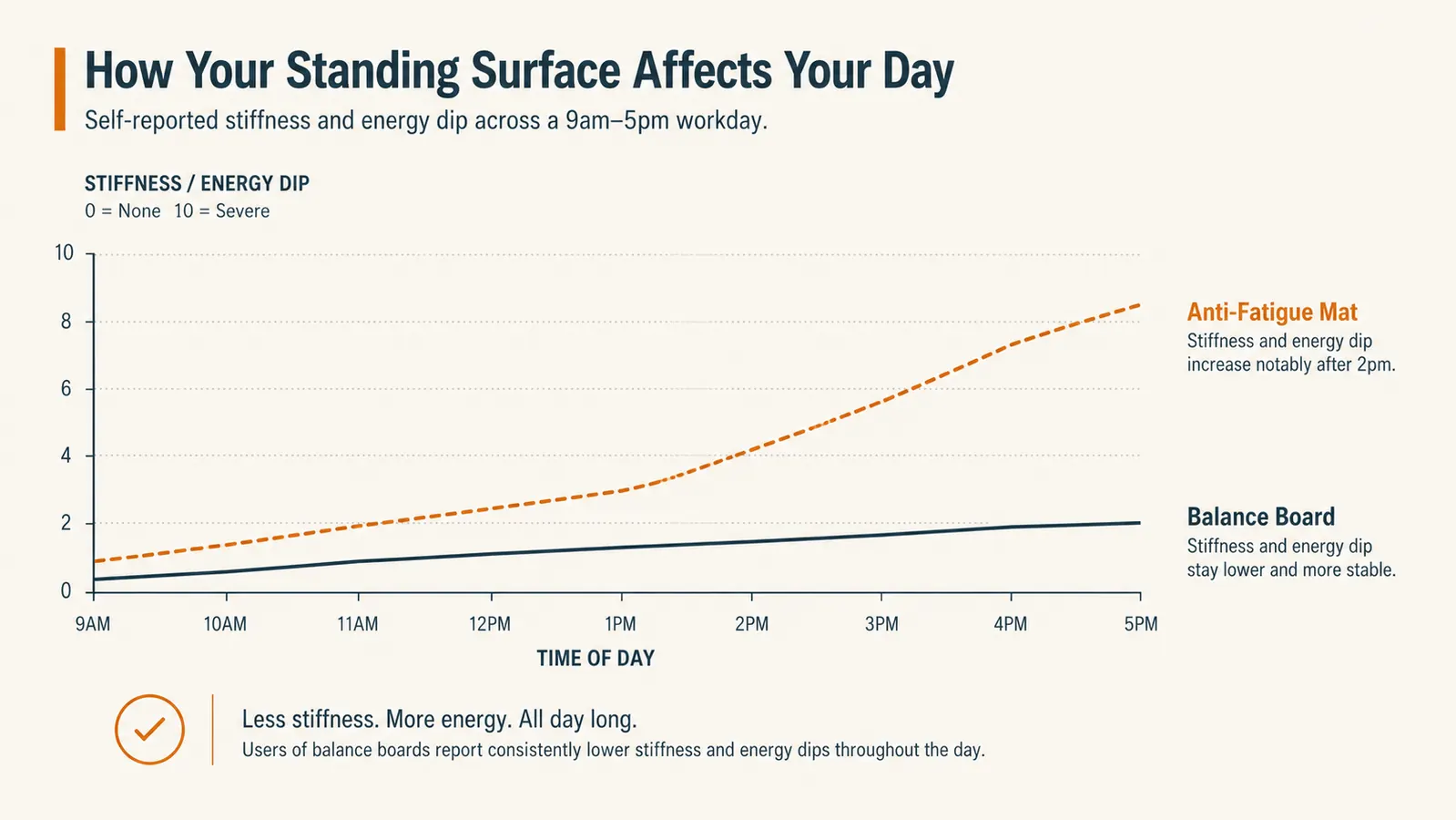
It also solved something the mat never touched, my afternoon energy dip. I used to hit a wall around 2:30 most days, the kind where I'd catch myself slouched over my keyboard even while standing. On the balance board, that dip is smaller and shorter. I think it comes down to my body doing low-level work the entire time, small stabilizing movements in my ankles and core, so I'm never fully static long enough to get sluggish. The board is solid birch, no foam to break down, and after three months of daily use mine shows zero wear beyond a little polish worn off the top coat where my heels sit.
There's a posture angle too that I didn't expect going in. Standing flat-footed on a mat, I noticed I'd slowly lean into one hip over the course of an hour, the same lazy lean I used to do sitting in a chair. The StrongTek makes that lean physically uncomfortable almost immediately, so it self-corrects. My physical therapist actually approved of this when I mentioned it, she said the constant small corrections are closer to what she'd assign as a balance exercise than anything a static surface can offer.
A mat cushions the fact that you're standing still. The board just doesn't let you stand still in the first place.
Where an Anti-Fatigue Mat Wins
I'm not going to pretend the mat has no place here, because it solved a real problem for two years before I'd ever heard of a balance board. If you're on back-to-back video calls where the camera can see your upper body moving, a mat is the safer choice. You can stand on it completely still for an hour long client call and look perfectly professional, where a balance board takes practice before you can hold a rock steady frame on camera. There's also zero learning curve. You unroll it, you stand on it, you're done.
A mat is also the right call if you have any ankle instability, a past sprain, balance issues, or you're simply not steady on your feet. The StrongTek board is stable once you've got the hang of it, but that first week does involve some wobbling, and if balance is a real physical concern for you rather than a minor inconvenience, that's not something to push through. A flat, cushioned surface removes that risk entirely while still taking pressure off your joints compared to bare flooring.
It's also the lower-friction pick if more than one person uses the same desk. My wife works from our kitchen island some afternoons and just needs somewhere comfortable to stand for twenty minutes without any adjustment period. Handing her the balance board mid-workday isn't realistic, but stepping onto a mat requires zero explanation.
Sore Feet Aren't Why You're Dragging by 3pm
A cushioned mat quiets the ache in your feet. It does nothing for the stiffness that comes from standing frozen in one spot for nine hours straight. The StrongTek Wooden Balance Board keeps your ankles and core working the whole time you're on your feet, which is the actual fix for that afternoon wall. Check today's price and see if it's still in stock.
Amazon Check Today's Price on Amazon →The Real Difference: Standing Still vs Standing in Motion
The mat and the balance board are answering two different questions, and that's the part most comparison pages skip. A mat answers, how do I make hard flooring less punishing. A balance board answers, how do I avoid being still for nine hours straight. Both are legitimate problems at a standing desk, but they're not the same problem, and buying a mat to fix restlessness is like buying a softer chair to fix the fact that you never get up. It helps a little. It doesn't fix the actual issue.
In my case, after switching over to the StrongTek board about six weeks into the test, I noticed I was naturally shifting my weight, rolling through my heels, adjusting my stance every couple of minutes without thinking about it. That's exactly the kind of low-grade movement physical therapists recommend for people who sit or stand in one position too long. The mat never gave me that. It just made the standing part hurt less, which is worth something, but it's a lower ceiling on what it can actually fix.
There was one Tuesday about two months into the test, a nine-hour day packed with back-to-back sprint reviews, where I could feel the difference in real time. I'd been on the mat that week and by the third hour I was shifting from foot to foot just to stay comfortable, the kind of fidgeting that pulls your attention off a client's screen share. The following Tuesday, same meeting load, on the StrongTek board, I never noticed the urge to fidget at all. My legs were already doing something, so there was nothing left over to distract me.
Price and How Each Holds Up Over Time
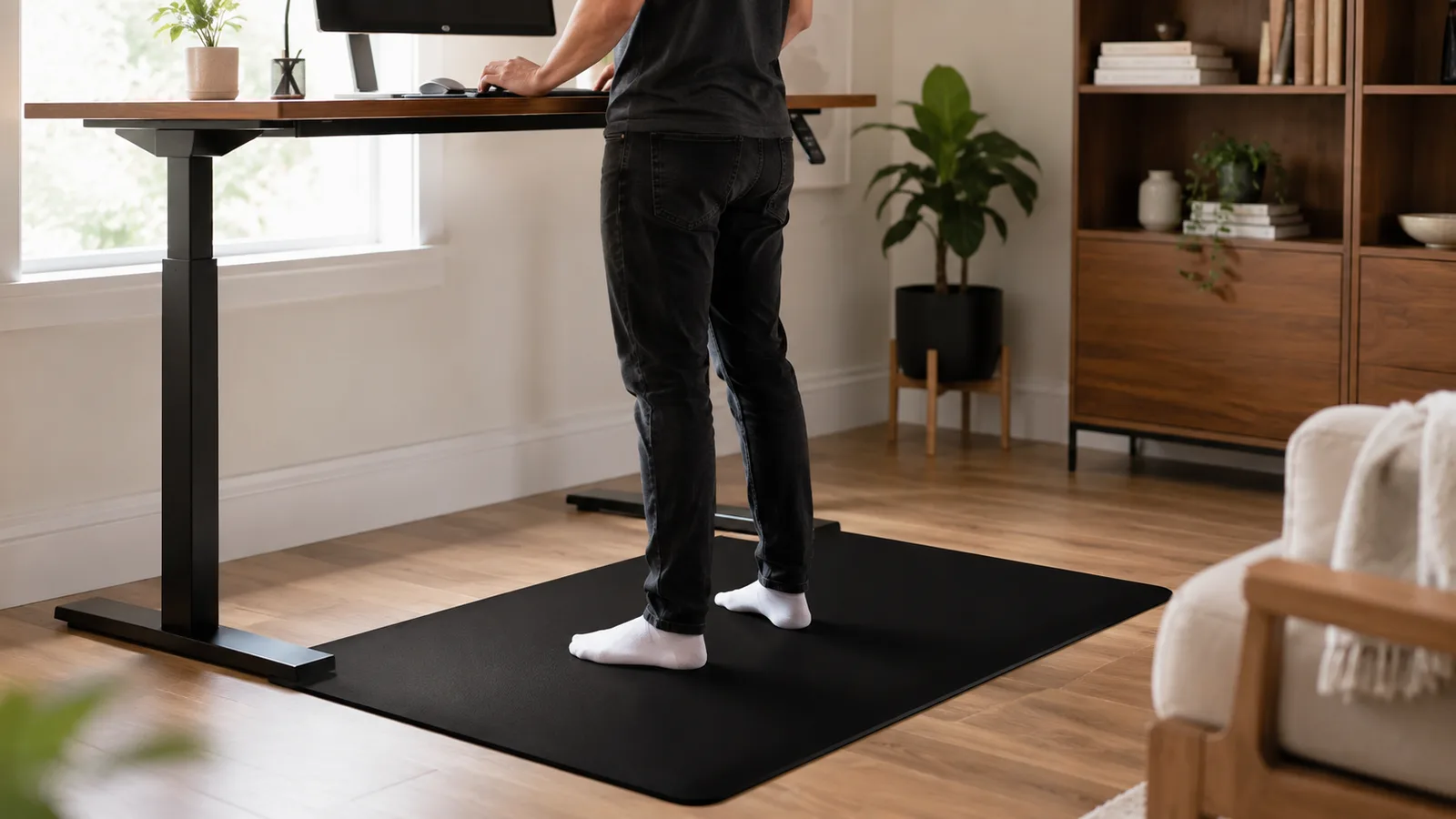
On price, they land in roughly the same range, the StrongTek and a decent anti-fatigue mat are comparably priced depending on thickness and brand, so cost isn't really the deciding factor here. Where they diverge is what happens a year or two in. My old mat started showing permanent foot-shaped compression marks after about 14 months, the foam just stopped bouncing back, and by month 20 it had gone noticeably flatter under where I stand most, which put me right back to standing on something closer to bare floor.
Solid wood doesn't have that failure mode. There's no foam to compress, no gel to separate, nothing to break down under repeated pressure in the same spot. The only maintenance I've done on the StrongTek in three months is wiping it down, and the non-slip surface still grips exactly like it did on day one. If you're the type who keeps gear for years rather than replacing it annually, that durability gap matters more than the sticker price.
Who Should Buy Which
If you're brand new to standing desks and just need your feet to stop hurting for the first month, start with a mat. It's the lower commitment choice and there's no adjustment period, and it's a fine way to find out whether standing desk life is even for you before spending more.
If you've already been standing for a while and you're now dealing with the restlessness, the afternoon slump, or general stiffness that a soft surface hasn't fixed, that's exactly the gap the StrongTek Wooden Balance Board is built for. I use mine every day now and keep the mat folded in the closet for the rare day I'm on camera for an hour straight and need to stand completely still. For most people reading this, that's the honest split, mat for the easy on-ramp, StrongTek board for the problem a mat was never designed to solve.
I Kept the Mat. I Use the Board Every Day.
Both have a place in my office, but only one of them changed how I feel by 5pm. If you're standing at your desk and still feeling stiff, restless, or wiped out by mid-afternoon, the StrongTek Wooden Balance Board is the one worth trying first.
Amazon Check Today's Price on Amazon →