

My desk used to have three layers of sticky notes on it by Wednesday, and by Friday I couldn't tell you what half of them meant anymore. A phone number with no name attached. A dollar figure with no context. An arrow pointing at nothing, stuck to the edge of my monitor like insulation.
I'm Nate Colburn. I've worked remote as an IT project manager for eight years now, out of a spare bedroom office in Ohio. My whole job runs on notes, deployment windows, ticket numbers, action items I'll need again in three weeks. For most of that time my system was whatever notebook was closest, plus a rotating cast of sticky notes. It worked until my wife got tired of watching me dig through torn paper and handed me a Rocketbook Flip she'd ordered without asking me first.
The push came from a specific afternoon before that. I'd scribbled a server migration window on a torn half sheet and stuck it next to three other torn half sheets that all looked the same by Friday. I grabbed the wrong one, confirmed the wrong time with a client, and spent a Saturday morning smoothing over an email I shouldn't have had to send. Nothing broke, but it was close enough that I sat there afterward actually irritated at a piece of paper.
The notepad sat in its plastic sleeve on my desk for about four days before I opened it. I'm not usually the guy who buys the gadget everyone online is talking about. But I was tired of hunting through torn scraps for a phone number I'd written down an hour earlier, so I gave it a real try instead of a five-minute skim.
I stopped losing notes the week I stopped needing new paper to write them on.
Desk Buried Under Sticky Notes You Can't Find Again?
Mine looked exactly like that until my wife handed me a Rocketbook Flip. One notepad, one place for everything, and nothing torn or stuck to my monitor anymore. See today's price on Amazon.
Amazon Check Today's Price on Amazon →The first meeting I used it in was a Tuesday architecture review with four people on the call, the kind where somebody drops a hostname or a ticket number you need three days later, not right now. I wrote through the whole hour on one page, dated at the top the way I always do, and when the call ended I opened the companion app, snapped a photo of the page, and it landed in a folder I'd already set up called Architecture Notes. Took about fifteen seconds.
You can send scans to a shared drive, a specific email address, or just keep them inside the app itself. I mostly use two destinations, a folder my project team can see and my own email, so there's a running paper trail for change requests without an actual paper trail sitting on my desk.
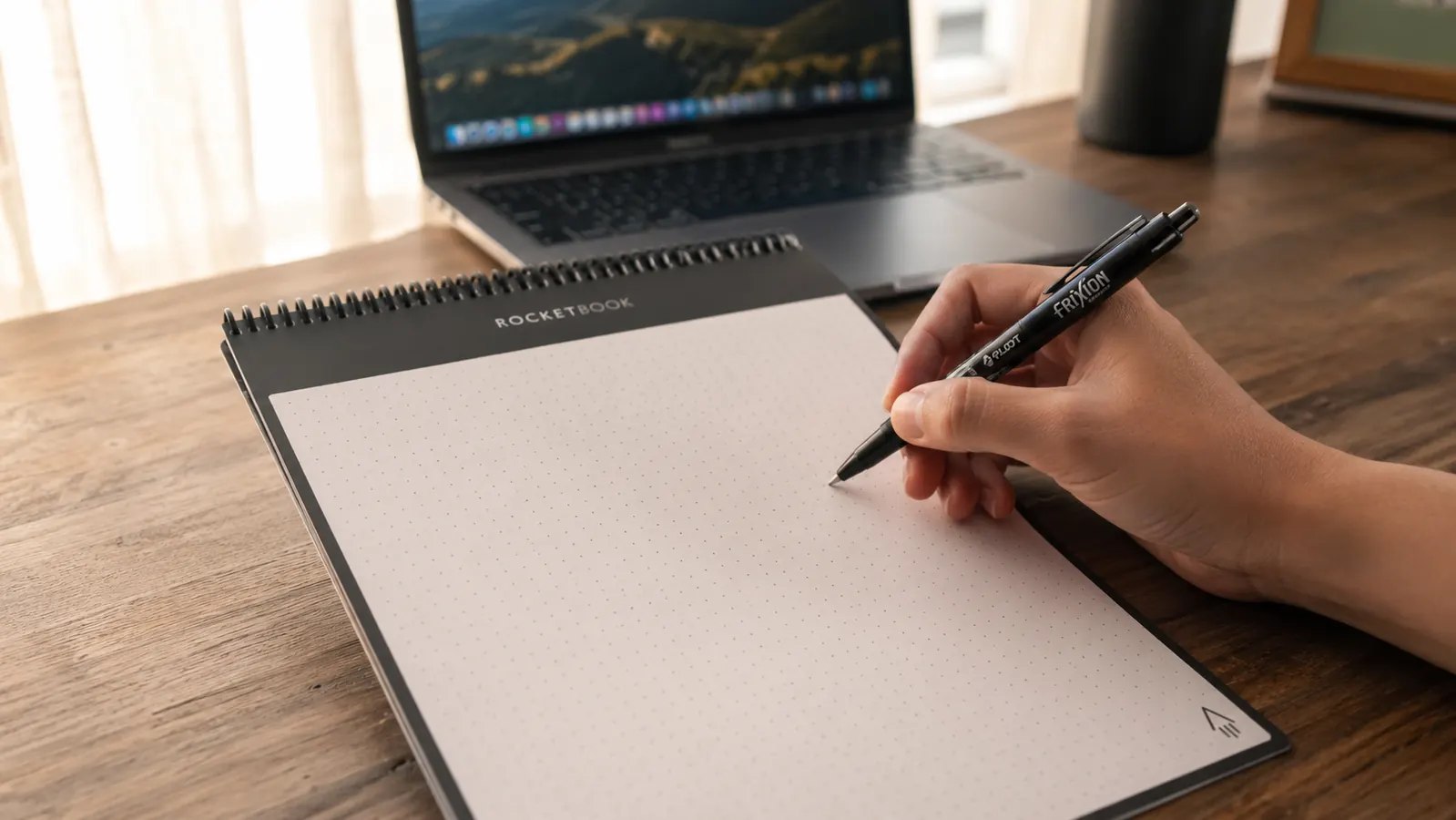
The idea is simple enough that I was skeptical it would hold up under daily use. Seven page templates cycle underneath the front cover, lined pages for meeting notes, dotted pages for the diagrams I sketch during architecture discussions, a to-do template I use most mornings. You write on it with the pen it comes with, scan the page when you're done, tag it to wherever it needs to live, then wipe the page with the included damp cloth and it's blank again.
I was sure the wiping part would be the weak link. Eight months in, my pages haven't ghosted or stained the way I braced for. Thirty seconds per page with a damp microfiber cloth I keep in the same drawer as the pen, and it comes back close enough to blank that I don't think about it. The one habit I had to build was scanning before wiping. I got impatient once early on and wiped a page before scanning it, and I lost a set of notes I actually needed. That's on me, not the notepad.
Before this, I was buying a fresh spiral notebook every ten or eleven weeks, plus a pack of sticky notes on the same drugstore run every month. It wasn't much money on its own, but it added up to a stack of half-filled notebooks in a drawer I never opened again once they were full. This one notepad has been the only one on my desk since October.
A coworker asked about it on a call last month after she saw me scan a page mid-meeting. I gave her the honest version, that it took about a week to build the habit of scanning before wiping, and that the pen is a specific kind, a Pilot FriXion, so you can't just grab whatever pen is closest to you. Small thing, but worth knowing before you start.
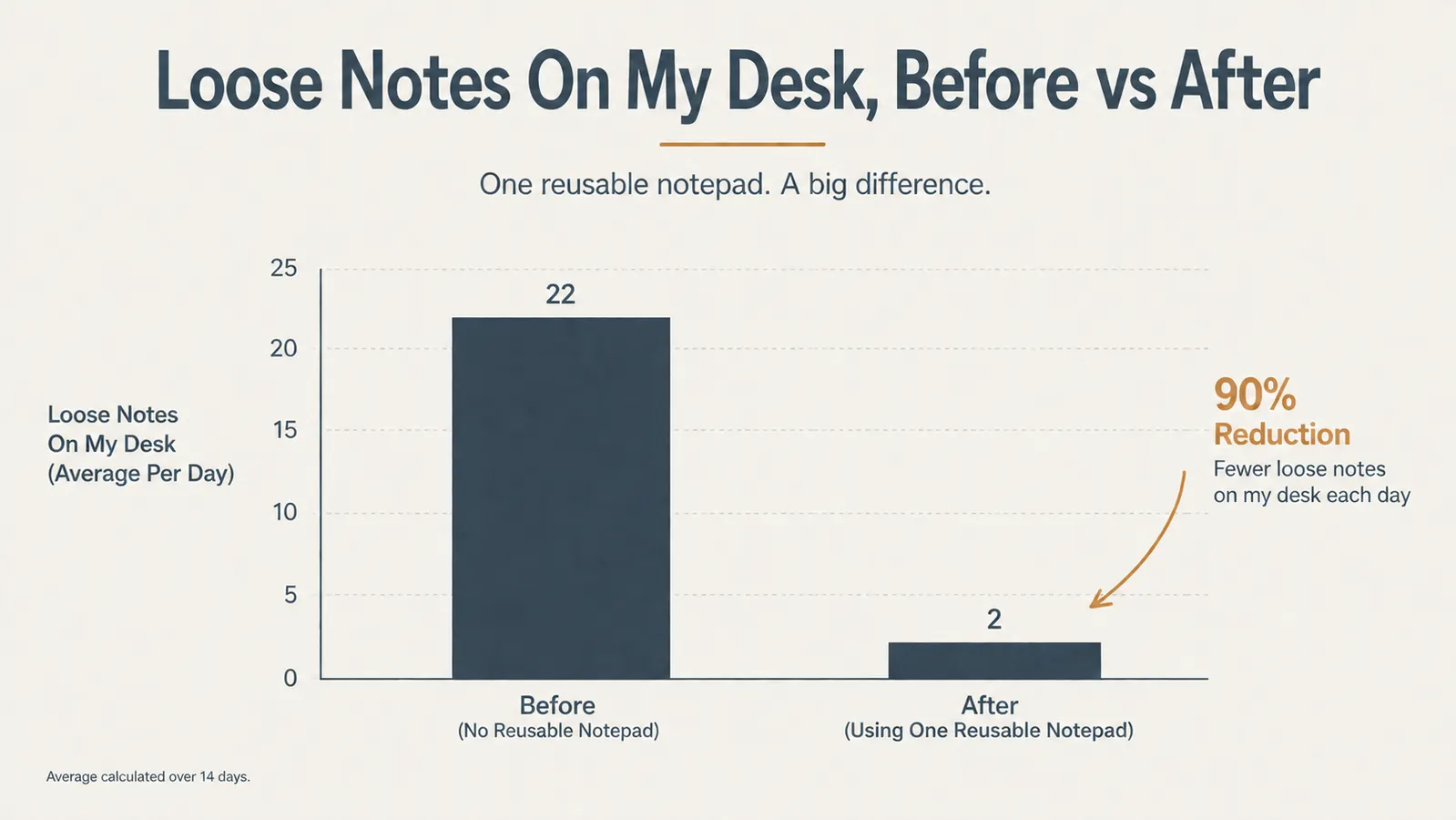
What actually changed my desk wasn't the technology so much as it was that I stopped generating loose paper in the first place. No more torn half sheets. No more digging through three notebooks for the one with a vendor's callback number written in it somewhere. Everything meeting-related lives in the same 8.5x11 pad, and everything gets scanned into folders I set up once and haven't touched since. My desk looks like a desk again instead of a project board.
What I'd Tell You If We Were Sitting at My Kitchen Table
If you asked me over coffee whether this thing is worth it, I'd tell you the truth. It won't fix a disorganized brain by itself. You still have to write the note and still have to tag it right in the app, or it just sits there unsorted like everything else did. But if your actual problem is that paper piles up and you lose the one note you needed, this solved that for me in a way sticky notes never came close to. It's not expensive, and if it ends up sitting in a drawer after a month, you're not out much. For me, it didn't sit in a drawer.
Ready to Clear the Sticky Notes Off Your Desk?
One notepad, wiped and reused for eight months, replaced the drawer full of half-used notebooks and the sticky notes stuck to my monitor. The Rocketbook Flip is worth trying at today's price before you buy another stack of paper you'll lose track of.
Amazon See Current Price on Amazon →